Yes, I know that this is not a water post, but this is the first anniversary of the passing of the husband of a great friend of mine. He was much too young when he, a non-smoker, was stricken with lung cancer and the world lost a great man. This post is to honor him and to help others find information on radon. The Department of Environmental Protection has some great ads recommending that people have their homes tested, but seriously, except for the Super Bowl, how many of us watch the ads?
We’ve known that increased radon concentrations have been associated with increased lung cancer rates in uranium miners. However, until 1984, we believed that the danger was primarily associated with miners and not with the general public. Stanley Watras, an engineer working on the Limerick Nuclear Power Station, tripped the radiation alarms at the power plant (some stories say as he entered the plant, others say as he leaves – I was in college and focused on studying so I don’t remember). None of his co-workers was tripping the alarms and no leaks were detected. Mr. Watras, however, was highly radioactive. So where did this come from? His house!
Mr. Watras’ house in Boyerstown, PA, sat on the Reading Prong, which contained radon-bearing rock and the radiation leaked into his home. Estimates are that he was exposed to the equivalent of 200,000 chest x-rays a year (YES, 200,000 chest X-rays PER YEAR). Uh-oh. At that point, the US EPA realized that this was a potential health problem to the general public. (https://spea.indiana.edu/magazine/Spring-2016/articles/barnes_stanley_radon.shtml)
You’re thinking – ok, that’s not great. Now what? You can check for the radon measurements in your town too. This won’t tell you what is in your house but it will tell you if there is something to have investigated. The main page for the PA DEP on radon is http://www.dep.pa.gov/Business/RadiationProtection/RadonDivision/Pages/default.aspx. And on this page, you can find a link at the bottom to the radon test data by zip code: http://www.dep.pa.gov/Business/RadiationProtection/RadonDivision/Monitoring/Pages/default.aspx.
As I said, I’m in the process of buying a house in Middletown and as part of the pre-closing inspections, I had a choice of adding radon testing to the proposed agreement. I had looked up the zip-code based data and found the following information.
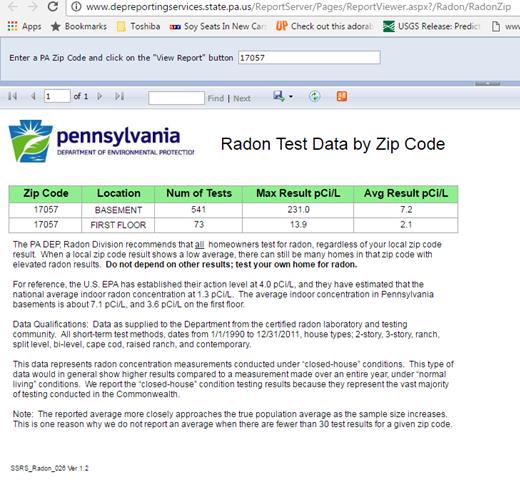
The recommended level is less than 4 pCi/L. The first floor of the buildings tested were fine on average, although at least one result exceeded average. However, the basement average exceeds the recommended limit and my washer and dryer are in the basement and I’m thinking about finishing part of the basement in the next few years (hello, woman cave!). So yes, I want radon testing!
I don’t have any results to post because the seller didn’t want it done while they still owned the house (legal liability, if known). I did agree to that stipulation and my home inspector will return in January at the same price for the inspection as he would had it been done with the general house inspection a couple of weeks ago.
I’m not using a home test kit to do it because some of the test kits are not reliable and I want a professional evaluation. So we’ll do it in January when the ground is frozen and/or wet and most likely to trap the radon. It should give me a feel for the maximum radon in the house. And then I can sleep better knowing if I need to install a basement ventilation system for the radon.
Ced and Andee, this is for the two of you.
 Rambling in the Rain