Modern times – the era of efficiency – always pushing for improving our way of life. But … it has resulted in a disconnect from the water cycle. We go into our houses and turn on a tap and we get a glass of refreshing water. Later, we flush our toilets and that wastewater magically is transported away from us. In a hard rain, the runoff passes over the grass and into the street until it finds an open grate and dumps into a pipe to go ‘who knows where’.
As our cities developed, drinking water, wastewater, and stormwater became three separate processes, often with three separate city managers. We broke the cycle of life by continuing what our recent ancestors taught us – bring water in and then once it is dirty or a nuisance, move it away as quickly as possible. We broke from the tradition of recycling water.
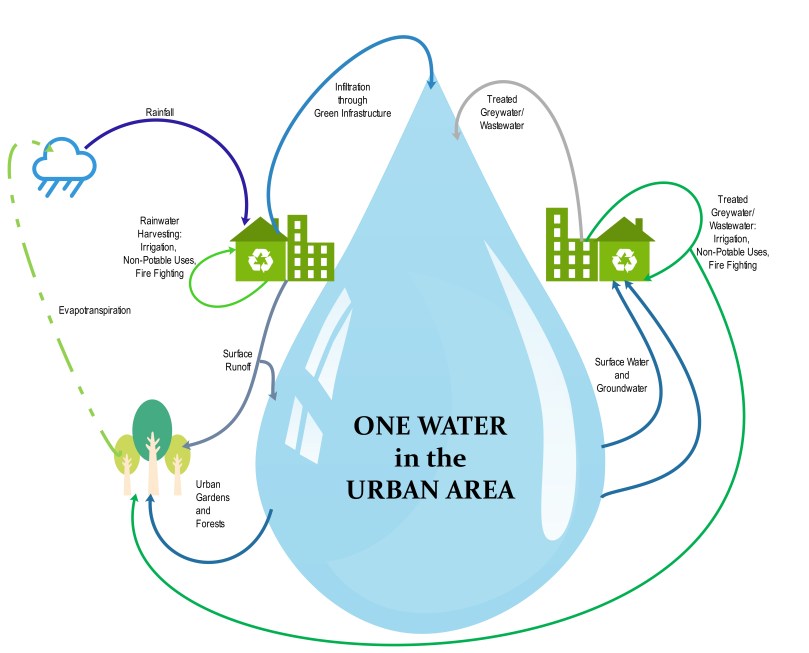
Now, as cities and regions experience water shortages and as treatment plants are overwhelmed due to population growth and aging infrastructure, innovators are thinking about restoring the balance. One Water. One Life.
(C) Copyright. Shirley Clark. 2019.
Wastewater and stormwater are no longer nuisances – they are opportunities waiting in the wings. Current uses for drinking water are evaluated to see which ones require potable water and which ones do not. Then, where we do not need potable water, these innovators propose replacing potable water with nonpotable water – either from treated wastewater or stormwater.
These opportunities come with nicknames, such as “purple pipes” that describe the pipe color that was originally used to designated systems carrying treated wastewater to outdoor irrigation uses such as golf courses or urban parks or even to houses to water their lawns. “Rainwater harvesting” to explain the process of reaping the rainwater on a roof and storing it for landscape irrigation or for toilet flushing.
Technologically, we can implement these opportunities. What we have to find in ourselves and in our communities is our will to treat water as the source of life – a precious resource. How to do this is the question?? How do we convince our neighbors that treated wastewater is safe for lawn irrigation or toilet flushing? How do we convince our building owners to capture rainwater from the roof and use it at their sites for irrigation or cooling towers or flushing toilets? What are our opportunities in older cities and older buildings?
Most importantly, how do we connect our children to the water so that they ask for what we did not – One Water, the fountain of life?
 Rambling in the Rain