My borough is thinking about an annual development fee. We have water quality issues and we have flooding issues. Some people call it a rain tax and wonder why we are taxing the rain. We are not taxing the rain. We are assessing a fee for how much you disturbed the land and interrupted the water cycle. When this was Penn’s Woods, most rainfall was returned to the atmosphere via the trees. Then we cut down the trees to put in farms and houses. And then more houses. And then other buildings. We removed the trees – those organisms that pumped the rain back to the atmosphere.
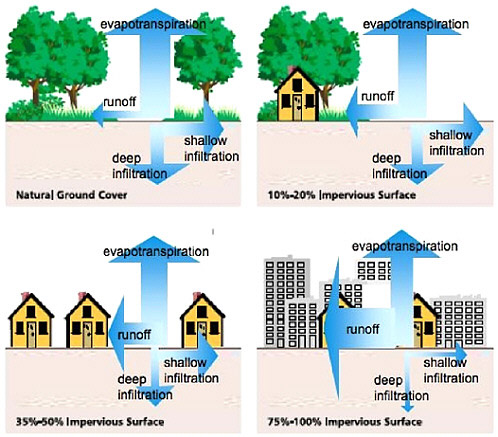 Source: US EPA
We also paved over a lot of the land so we could drive on it or park our cars at work all day on it. We needed compacted soils for our buildings, but for simplicity, we just compacted the entire development area. Now we have removed the pumps, we have blocked the soil from receiving the moisture it used to get, and we wonder why we flood.
So, that’s not a rain tax. It’s you paying for the impact that you have on the land, on the floodwater generation, on the transport of pollutants such as your fertilizers and pesticides, the oil from your car, and, yes, even your dog poop.
Every year, your property and how it is developed impacts the water. To illustrate, here are two lots and houses on the same street and a quick calculation of impervious area (areas where water can’t seep back into the soil where it belongs). The house+garage in the red is approximately 3,000 square feet while the house+garage in the blue is 1,700 square feet, plus the house in red has a larger driveway and sidewalk.
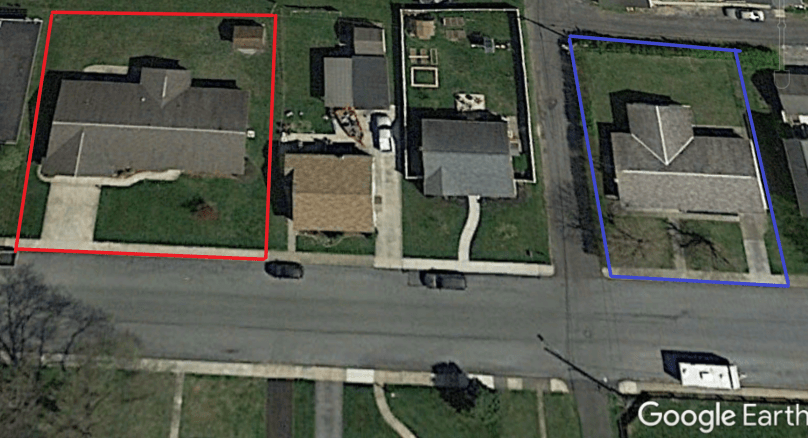
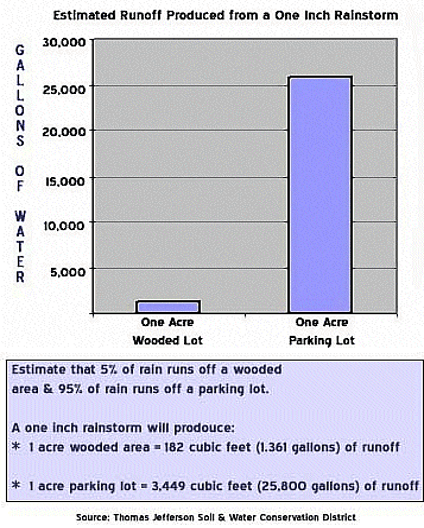
Therefore, using the graph above, the 1,700 square foot house space (if the house wasn’t there and the soil was healthy), would generate approximately 53 gallons of runoff, but the house roof creates 1,000 gallons of runoff. The 3,000 square foot house space pre-development would generate 94 gallons of runoff and, after the house blocked the soil, would generate 1,770 gallons of runoff. Almost twice the size results in almost twice the runoff. Most importantly, covering up the soil results in almost 20 times more runoff than the undeveloped property. That runoff has to go somewhere and someone has to pay to keep the system maintained and periodically replaced. Your house, your choice of impact. That’s why most fees are based on impervious area, although it is easier to calculate it based on property value. Now, check to see if you can get a credit for being a good steward and improving what you can so you can keep the stormwater you generated on your own property and reduce flooding.
 Rambling in the Rain