The month of January is designated as National Radon Action Month by the U.S. Environmental Protection Agency. I thought this post about my own journey with home ownership and radon would be fitting even though it is almost April. Unlike my co-author who previously wrote about radon and her personal experience here, I, probably like most people, didn’t have radon on our radar. With the first house we went into contract with, we didn’t opt to have a radon test as part of our inspections. I also figured that I planned on going in and out of one section of the basement, so that would air out any gases present in the basement if there were any. Of course, reading up on radon, that’s not how it works to remove radon. Naturally occurring uranium in the soil decays into radon gas. This gas moves through the soil profile and into the air, water, or our homes. Here is a link to EPA’s literature on radon and Kansas State University’s National Radon Program Services page.
After reading my co-author’s post, I was curious and I decided to check out what the radon level is reported to be in the area I planned on buying the house. Using the link she provided: http://www.dep.pa.gov/Business/RadiationProtection/RadonDivision/Monitoring/Pages/default.aspx, this was my result.
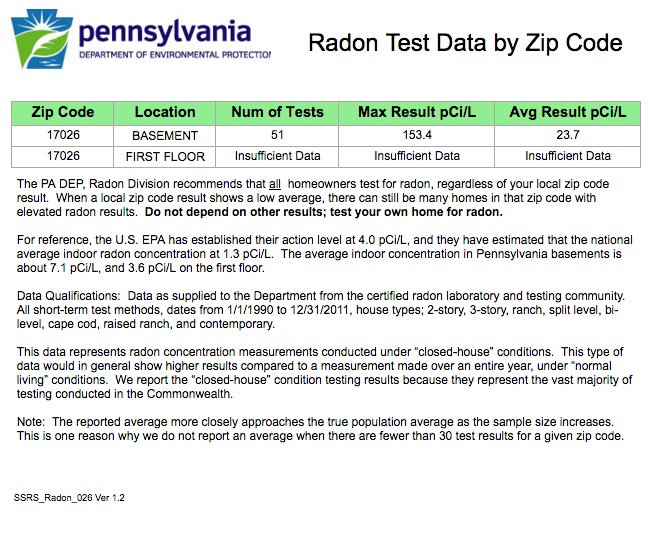
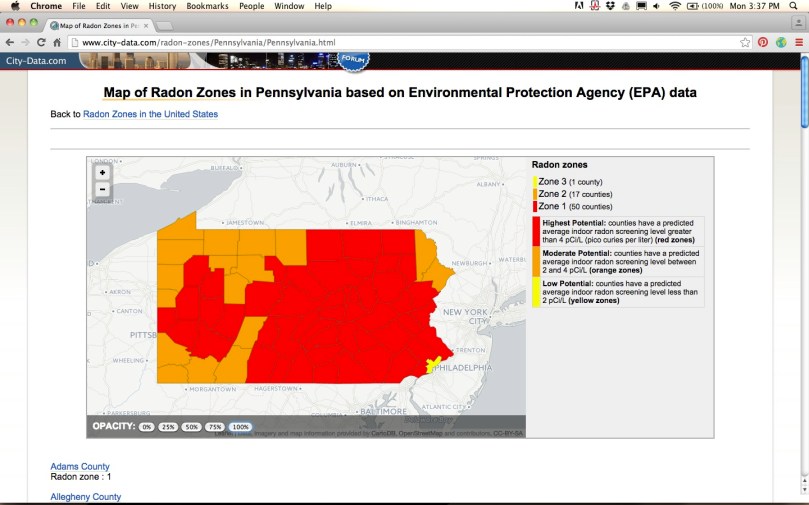
To my chagrin and horror, the basement had the potential to average about 24 pCi/L. The maximum limit is 4 pCi/L! But since that house fell through, I suppose that was a relief. Upon further investigation, the entire state of Pennsylvania contains concentrations of radon, most of it is in Zone 1 where the concentration is highest.
Finding the house we finally purchased, this time, I wanted the radon test done. Going to PA’s DEP zip code radon lookup link again, this is what I got.
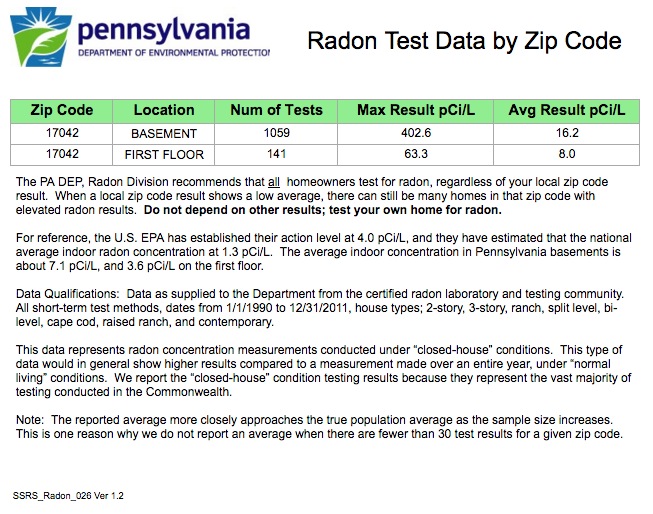
So, not as bad as the first area but still significantly higher than 4 pCi/L. The first floor is quite high as well. These numbers gave me a ballpark of what I could possibly encounter at the home I wanted to purchase. Our test was shorter than I expected but plotting the available data points, here is a graph. 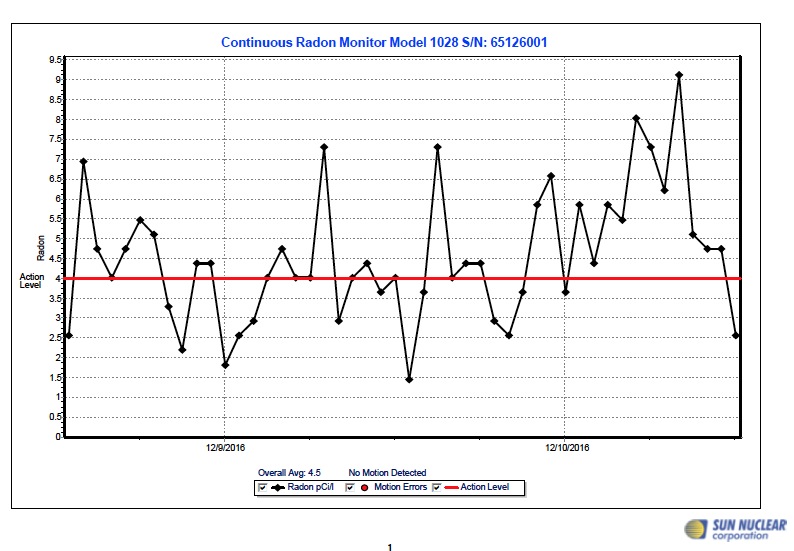
I only opted to test the basement and not the first floor. The test was a 48 hour test. The average radon concentration was 4.5 pCi/L which is above the EPA limit of 4.0 pCi/L. Out of the 48 points of data collected, over half were above the limit. About a third of the data points were below the limit and the remainder were at the limit (based on the graph). With the results, we were able to ask the seller to either install a radon system or give us credit so we could have one installed when we moved in. The seller opted to install the system. Here are a few images of the system.
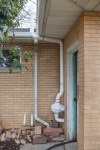
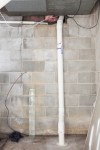

I would have really preferred that the discharge pipe did not go through the window well and through the shed (coincidentally, where the sump pump discharge pipe exits the building as well). I’m assuming the seller bought the most basic system available and that the system is sub-slab depressurization. The crawlspace adjacent to the utility room is soil and rubble from what I heard. I haven’t ventured into that space yet and it has a lot of debris that requires cleanup. From what I can see, it’s not covered with any plastic cover to create negative pressure. The sump pump in the main area of the finished portion of the basement was untouched as well. I’m not sure if this is typical treatment or not. I have read on various websites that crawlspaces and sump pumps should be treated as well.
The mitigation company’s initial radon reading was 6.0 pCi/L. Another radon test was taken after the system was put in place. Results came back as radon testing, they write the following:
There is no known safe level of exposure to radon since lung cancer can result from low exposures to radon. Exposure to radon at the EPA Action Level of 4 pCi/L poses a significant health risk. EPA based the 4 pCi/L Action Level on four factors: the health risk involved; the effectiveness of available mitigation technologies; cost-effectiveness; and, the goal set by Congress to reduce indoor radon levels to as close to the outdoor level as possible. EPA’s estimate of radon-related lung cancer deaths is based on the population of the U.S. exposed to the national average indoor radon concentration of 1.3 pCi/L over a lifetime. Existing mitigation technologies allow the radon level in most homes to be reduced to 2 pCi/L or less most of the time.
Additional EPA recommendation: To help minimize your future risk, you should also seriously consider taking action to fix your home if your radon level is between 2 pCi/L and 4 pCi/L.
So, it appears that we still have further action to take if we want to be below 2pCi/L and not just 4 pCi/L. However, this may be more difficult to achieve. It is suggested that radon be retested every 2-5 years. It looks like we’ll have to put that on our maintenance schedule.
 Rambling in the Rain